Blog
Load Cell Output Explained: mV/V, Excitation Voltage and Signal

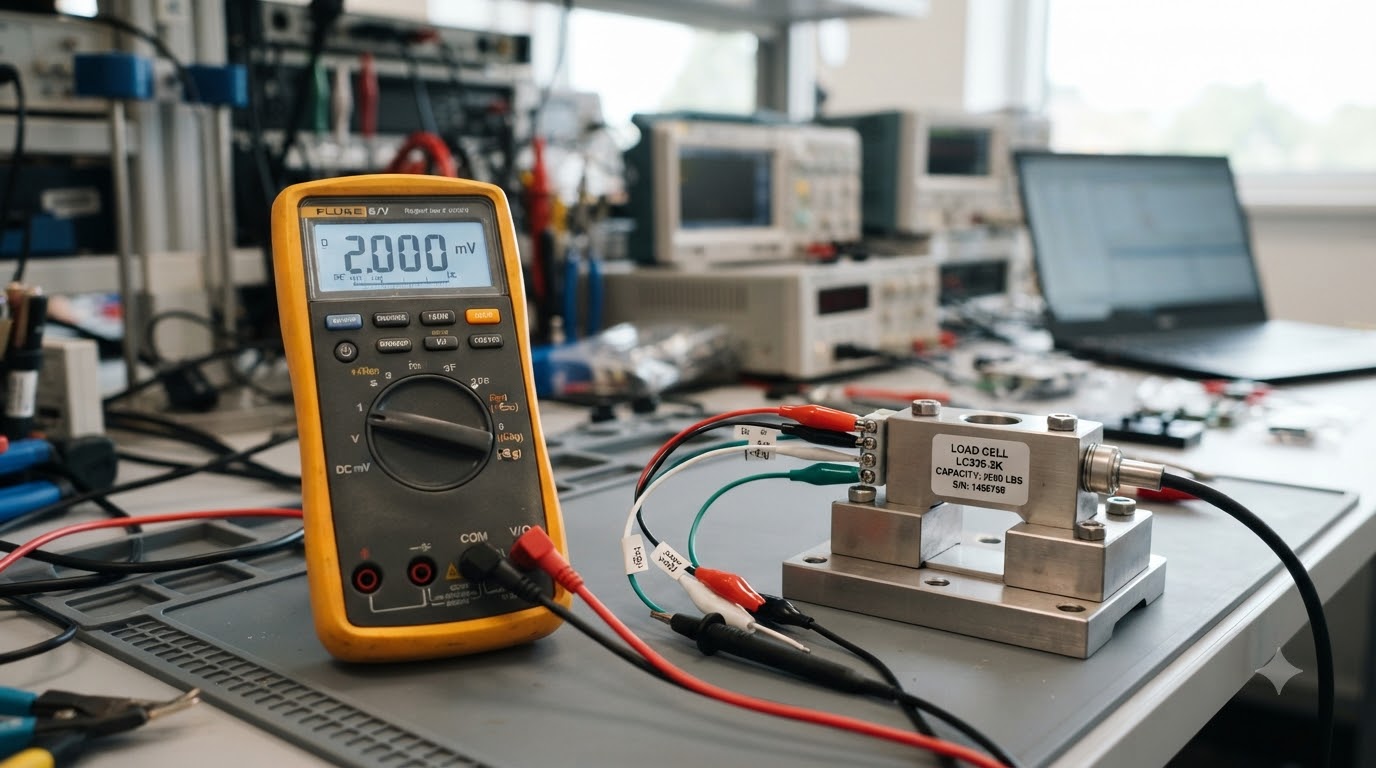
A load cell typically produces a very small differential electrical signal specified in mV/V (millivolts per volt). This rating describes the load cell’s full-scale output relative to the excitation voltage supplied to its internal strain-gauge bridge.
For example, a load cell rated at 2 mV/V with 10 V excitation produces:
2 mV/V × 10 V = 20 mV full-scale output
This means the load cell can produce approximately 20 mV at its rated capacity under the specified excitation conditions. The actual output at a particular load will depend on the applied load and the load cell’s characteristics.
This guide explains mV/V output, excitation voltage, load cell output calculations, and how the small electrical signal is converted by an indicator or signal conditioner into a usable weight or force measurement.
What Is the Output of a Load Cell?
A load cell normally produces a very small differential electrical signal specified in mV/V. It is a ratio rather than a fixed voltage, meaning the actual output depends on both the load cell’s rated sensitivity and the excitation voltage supplied to the bridge.
As the applied load increases, the load cell output increases proportionally within its specified measurement range. The signal is measured across the load cell’s signal terminals and is typically only a few millivolts at full load.
Because this signal is very small, it normally needs to be connected to an indicator, amplifier, transmitter, signal conditioner, or data acquisition system (DAQ) before it can be displayed, recorded, or used for control.
What Does mV/V Mean?
The mV/V rating indicates how many millivolts the load cell produces for each volt of excitation at its rated or full load.
For example, a 2 mV/V load cell produces approximately:
| Excitation Voltage | Full-Scale Output |
|---|---|
| 5 V | 10 mV |
| 10 V | 20 mV |
| 15 V | 30 mV |
The calculation is:
Output = Rated Output (mV/V) × Excitation Voltage (V)
These values represent approximate full-scale output and should always be checked against the manufacturer’s specifications, including excitation limits and rated output tolerance.
How Does a Load Cell Produce an Electrical Signal?
A load cell converts mechanical force into a small electrical signal through a strain-measurement process:
Force → Strain → Strain Gauges → Wheatstone Bridge → mV/V Output
When a load is applied, the load cell’s elastic element deforms slightly. This deformation causes the bonded strain gauges to stretch or compress, changing their electrical resistance.
The strain gauges are arranged in a Wheatstone bridge circuit. When the load cell is unloaded, the bridge is designed to remain close to balance. As the strain gauges change resistance under load, the bridge becomes unbalanced and produces a small differential voltage across the signal terminals.
This differential signal is expressed as mV/V, with the actual output depending on the load applied and the excitation voltage supplied to the bridge.
For a deeper explanation of the sensing principle, see LCS-03 Strain Gauge Load Cells and LCS-05 Wheatstone Bridge. These topics explain how strain gauges and bridge circuits work together to convert mechanical deformation into a measurable electrical signal.
What Is Load Cell Excitation Voltage?
Load cell excitation voltage is the electrical supply used to power the strain-gauge Wheatstone bridge inside a load cell. The excitation provides the reference voltage that allows the bridge to generate its small differential output signal.
Common excitation values include 5 V, 10 V, and 15 V, but the correct voltage must always be selected according to the manufacturer’s specifications.
Recommended Excitation
The recommended excitation voltage is the value specified by the manufacturer for normal operation. Using the recommended value helps achieve the expected output while maintaining suitable electrical and thermal performance.
Maximum Excitation
Load cells may also have a specified maximum excitation voltage. This limit should not be exceeded, even if a higher voltage could theoretically produce a larger output signal.
Stable Excitation Supply
A stable excitation supply is important because changes in excitation voltage can affect the load cell’s output. The indicator or signal-conditioning system should provide a suitable, regulated supply within the load cell’s specified range.
Excessive Excitation and Heating
Higher excitation increases the electrical power dissipated by the strain-gauge bridge. Excessive excitation can therefore cause self-heating, which may affect measurement stability and temperature-related performance.
For this reason, excitation voltage should always remain within the manufacturer’s specified operating range, with particular attention to recommended and maximum values.
How to Calculate Load Cell Output
The full-scale electrical output of a load cell can be calculated from its rated output in mV/V and the excitation voltage supplied to the bridge.
Formula
Full-scale output (mV) = Rated output (mV/V) × Excitation voltage (V)
The result represents the approximate differential signal produced at the load cell’s rated capacity. Actual output can vary within the manufacturer’s specified tolerance.
Example 1: 2 mV/V Load Cell
Rated output = 2 mV/V
Excitation = 10 V
2 × 10 = 20 mV
Therefore, the load cell produces approximately 20 mV at full rated load.
Example 2: 3 mV/V Load Cell
Rated output = 3 mV/V
Excitation = 5 V
3 × 5 = 15 mV
The approximate full-scale output is therefore 15 mV.
Example 3: 1 mV/V Load Cell
Rated output = 1 mV/V
Excitation = 10 V
1 × 10 = 10 mV
Therefore, the approximate full-scale output is 10 mV.
Load Cell Output Voltage Table
The following table shows the theoretical full-scale output voltage for common load cell sensitivities at different excitation voltages. It can be used as a quick reference when estimating the signal available from a load cell at its rated capacity.
| Rated Output | 5 V Excitation | 10 V Excitation | 15 V Excitation |
|---|---|---|---|
| 1 mV/V | 5 mV | 10 mV | 15 mV |
| 2 mV/V | 10 mV | 20 mV | 30 mV |
| 3 mV/V | 15 mV | 30 mV | 45 mV |
For example, a 2 mV/V load cell supplied with 10 V excitation has a theoretical full-scale output of 20 mV.
How Does Load Affect Load Cell Output?
A load cell’s electrical output generally increases as the applied load increases. Within its specified operating range, the relationship is designed to be approximately linear, making it possible for an indicator or signal conditioner to convert the electrical signal into a corresponding weight or force measurement.
For example, a 2 mV/V load cell with 10 V excitation has a theoretical full-scale output of 20 mV.
At 50% load:
20 mV × 50% = 10 mV
At 25% load:
20 mV × 25% = 5 mV
So, in an ideal linear example, half the rated load produces approximately half the full-scale output.
In practice, real load cells are not perfectly linear. Accuracy, linearity, hysteresis, repeatability, temperature effects, creep, and other specified performance characteristics can cause the actual output to differ slightly from the ideal calculation.
How Do You Convert Load Cell Output to Weight?
A load cell’s measured output can be converted to an approximate load value by comparing the measured signal with the calculated full-scale output. For an ideal linear system:
Applied load = Measured output ÷ Full-scale output × Rated capacity
Example
Consider a load cell with:
- Rated capacity = 1,000 kg
- Rated output = 2 mV/V
- Excitation = 10 V
- Measured output = 10 mV
First, calculate the full-scale output:
2 × 10 = 20 mV
Then calculate the applied load:
10 ÷ 20 × 1,000 = 500 kg
Therefore, the theoretical measured load is approximately 500 kg.
This calculation is useful for understanding the relationship between load cell output and applied load. However, practical weighing systems should not rely on this calculation alone. Calibration, zero adjustment, temperature effects, signal conditioning, mechanical installation, and the load cell’s specified accuracy and linearity can all affect the final measurement.
A properly configured weighing indicator or measurement system uses calibration and compensation to convert the load cell signal into an accurate weight reading.
Load Cell Output Signal and Signal Conditioning
The raw output from a load cell is a very small mV/V differential signal, so it normally cannot directly drive a PLC, industrial controller, or other equipment. Signal conditioning is used to amplify, filter, convert, or process this small signal into a form that the measurement or control system can use.
A typical measurement chain is:
Load Cell → Signal Conditioner/Amplifier → Indicator/DAQ/PLC → Software
An amplifier increases the small load cell signal to a more usable voltage level. A signal conditioner can also provide functions such as filtering, excitation, isolation, or signal conversion, depending on the device.
A weight indicator is designed to process the load cell signal and display the measured weight. ADC and DAQ systems convert the analogue signal into digital data for recording, monitoring, and analysis.
For industrial automation, the conditioned signal may be connected to a PLC interface or converted to a standard industrial signal such as 4–20 mA using a suitable transmitter. The appropriate interface depends on the load cell, instrumentation, required accuracy, and control system.
What Happens If the Load Cell Output Is Too Low or Too High?
A load cell that produces significantly lower, higher, or unexpected output than specified may indicate an electrical, mechanical, configuration, or sensor problem. The measured signal should be compared with the manufacturer’s specifications before diagnosing the system.
Low Output
Low output can result from incorrect excitation voltage, wiring or connection problems, a damaged load cell, incorrect instrument configuration, or a problem with the amplifier or signal-conditioning equipment. Cable damage, poor connections, or incorrect wiring can also reduce or interrupt the signal.
High or Unexpected Output
Higher-than-expected output may be caused by incorrect excitation, wiring faults, overload or mechanical damage, installation problems, electrical interference, or incorrect calibration. Mechanical binding, side loading, or unwanted contact with surrounding structures can also affect the measured signal.
Load Cell Output vs Sensitivity
Rated output and sensitivity are closely related terms, but they should not always be treated as exactly the same. The terminology used can vary between load cell manufacturers and datasheets.
Rated output (mV/V) describes the electrical signal produced by the load cell at its rated load for a specified excitation voltage. For example, a load cell rated at 2 mV/V with 10 V excitation has a theoretical full-scale output of approximately 20 mV.
Sensitivity is often used to describe how much the load cell’s output changes in response to an applied load. In many load cell specifications, sensitivity is expressed in mV/V, but the exact definition and test conditions should be confirmed from the manufacturer’s datasheet.
Therefore, when comparing load cells, it is important to check the manufacturer’s terminology, rated output, excitation conditions, tolerance, and other relevant specifications rather than assuming that every datasheet defines these terms identically.
How to Choose the Right Load Cell Output
A higher mV/V output is not automatically better. The correct load cell output depends on the complete measurement system and how the sensor will be used.
Start by checking indicator or DAQ compatibility and the required excitation voltage. The load cell output must be suitable for the connected measurement equipment and signal-conditioning system.
Consider the required accuracy and rated capacity, along with the type of signal conditioning required. Cable length and installation conditions can also affect signal integrity, particularly in industrial environments.
Environmental factors such as temperature, moisture, dust, chemicals, and electrical interference should also be considered. Ultimately, the best output specification is the one that provides reliable measurement while matching the load cell, instrumentation, installation, and application requirements.
FAQs
What Is the Output of a Load Cell?
A load cell normally produces a small differential electrical signal specified in mV/V (millivolts per volt). The actual voltage depends on the excitation supplied and the load applied.
What Does 2 mV/V Mean?
A 2 mV/V load cell produces approximately 2 mV of output for every 1 V of excitation at rated load. For example, with 10 V excitation, the theoretical full-scale output is approximately 20 mV.
What Excitation Voltage Does a Load Cell Need?
The required excitation voltage depends on the manufacturer’s specification. Common values include 5 V and 10 V, but the recommended and maximum excitation limits should always be checked in the datasheet.
How Do You Calculate Load Cell Output?
The basic calculation is:
Full-scale output (mV) = Rated output (mV/V) × Excitation voltage (V)
For example, a 2 mV/V load cell with 10 V excitation produces approximately 20 mV at full rated load, subject to the manufacturer’s specifications.
Conclusion
Understanding load cell output is essential for selecting, wiring and integrating a load cell correctly. The output is typically specified in mV/V, while the actual signal depends on the rated output and excitation voltage.
For example, a 2 mV/V load cell supplied with 10 V excitation produces approximately 20 mV at full rated load. Correct excitation, signal conditioning, wiring and calibration are important for obtaining accurate and stable measurements.
By understanding mV/V ratings and using the correct output calculations, you can select a compatible load cell and measurement system for your application.