
Blog
Load Cell Accuracy and Quality Compared: Eleven Real Load Cells Side by Side

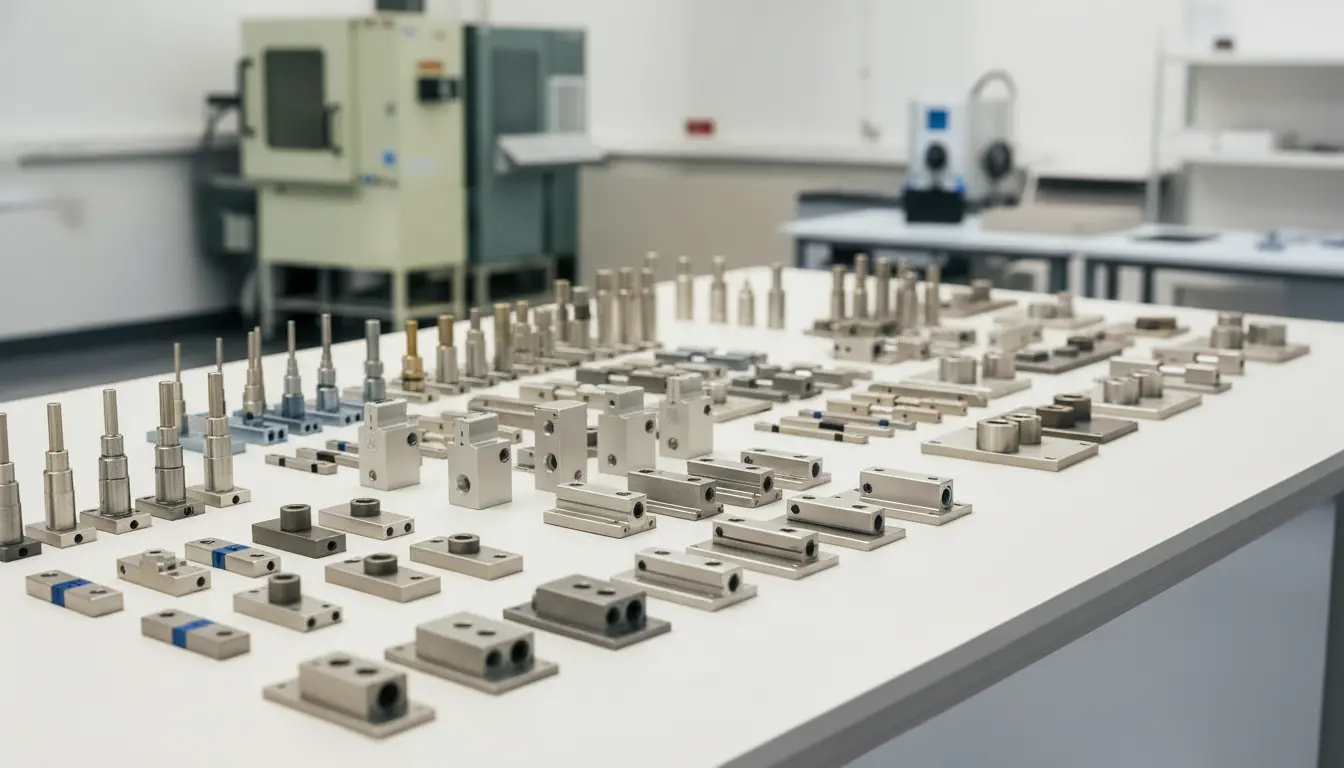
Load cell quality shows up in four places: the accuracy class and certification, the material and sealing, the environmental protection rating, and extras such as surge protection and matched outputs. A C6 load cell can support twice as many scale divisions as a C3, a hermetically sealed stainless steel cell survives conditions that would destroy a coated aluminium one, and a certified cell is a requirement for trade use. This guide compares eleven real load cells from our range side by side, turns the percentages into real kilograms, and shows how to decide how much quality a job actually needs.
What accuracy means for a load cell
A load cell datasheet can list several accuracy-related numbers. They sound similar but describe different things.
- Non-linearity: how far the output strays from a straight line between zero and full load.
- Hysteresis: the difference in reading between loading up and unloading.
- Repeatability: how closely it repeats the same reading.
- Creep: drift in the reading under a constant load over time.
- Combined or total error: a single figure that bundles several of these together. This is the number that makes quick comparisons easy.
All of them are usually given as a percentage of rated output (full capacity). If you want each term defined, read our load cell glossary.
Accuracy classes: what C3 and C6 mean
Load cells for scales that are used in trade are tested to OIML R60 and given a class letter and a number. The most common class is C. The number after it is the maximum number of scale divisions, in thousands, that the load cell can support while keeping its accuracy. So:
- C3: up to 3,000 divisions
- C6: up to 6,000 divisions
The practical meaning is resolution. Take a 500 kg load cell.
- As a C3 cell it supports a smallest verified step of roughly 500 divided by 3,000, which is about 0.17 kg (170 g).
- As a C6 cell it supports roughly 500 divided by 6,000, which is about 0.083 kg (83 g).
These are theoretical best cases. Real scales add their own errors from the platform, the mounting and the electronics. More about the classes is in load cell accuracy classes, and what the certificates mean for trade use is in legal for trade weighing in Australia.
Eleven real load cells compared
The figures below come from our product datasheets. Pick the version and capacity you need on the product page.
| Load cell | Style | Capacity | Material and sealing | Certification and accuracy |
|---|---|---|---|---|
| Model 1004 | Single point | 0.3 to 3 kg | Aluminium, IP66 | Total error under 0.0067% of rated output; OIML C3 and C6 |
| Model 1042 | Single point | 1 to 200 kg | Anodised aluminium, IP66, protective coating | OIML R60 and NTEP |
| Model 92001 | Single point | 50 to 1,500 kg | Alloy steel (stainless optional) | Cost-effective, for counting, bench and floor scales |
| Revere 5123 | Single-ended shear beam | 500 to 5,000 kg | Nickel-plated alloy steel, IP67 | OIML R60 3,000d; NTEP class III 3,000 divisions |
| Revere 9363 | S-type | 50 to 10,000 kg | Stainless steel, IP67 | OIML R60 3,000d; NTEP IIIL 10,000 divisions |
| Sensortronics 60063 | S-type | 500 to 20,000 lb | Stainless steel, welded seal, IP68 | NTEP IIIL 10,000d and III 5,000d; FM approved |
| Sensortronics 65016-W | Double-ended shear beam | 1,000 to 100,000 lb | Stainless steel, welded seal, IP67 | FM approved; matched outputs for multi-cell systems |
| Tedea-Huntleigh 355 | Bending beam | 5 to 500 kg | Stainless steel, hermetically sealed, IP68 | OIML R60 and NTEP |
| Revere RLC | Ring torsion | 250 kg to 60 t | Stainless steel, hermetic, IP66 and IP68; IP69K on some | OIML R60 and NTEP 6,000d |
| Revere ASC2 | Compression column | 30, 40 and 50 t | Stainless steel, hermetic, IP66, IP68 and IP69K | OIML R60 5,500d; NTEP IIIL 10,000d; built-in surge protection |
| Tedea-Huntleigh 120 | Compression | 3 to 50 t | Stainless steel housing, surge arrestors | 0.02% total error; 6-wire sense circuit |
Turning percentages into kilograms
Total error is quoted as a percentage of the cell’s rated output, so you can work out the worst-case error at full capacity.
- Model 1004 at 3 kg: 0.0067% of 3 kg is 0.0002 kg, which is 0.2 grams. That is why it suits jewellery and pharmacy scales.
- Model 120 at 50 tonnes: 0.02% of 50,000 kg is 10 kg. On a weighbridge, 10 kg out of 50 tonnes is a tiny fraction.
Remember these are single-cell figures. A complete scale with several cells, a platform and electronics will have a larger total error than any one cell, which is why trade scales are approved as complete systems.
Quality factor 1: material
| Material | Strengths | Limits | Examples |
|---|---|---|---|
| Aluminium | Light, accurate, low cost at low capacity | Not for wet, corrosive or hot-wash areas; lower capacity | 1004, 1042 |
| Alloy steel (plated or coated) | Strong, good value at medium and high capacity | Coating damage can lead to rust | 92001, 5123 |
| Stainless steel | Corrosion-resistant, hygienic, long life | Higher cost | 9363, 355, RLC, ASC2, 120 |
See load cell materials for more.
Quality factor 2: sealing and protection
- IP66 or IP67: fine for dusty, splashed or occasionally wet areas.
- IP68: suited to very wet or submerged duty.
- IP69K: hot, high-pressure washdown.
- Hermetically sealed (welded): the best long-term protection, because moisture cannot get in at all.
Moisture is the most common reason load cells fail, so spending a little more on sealing is often cheaper than replacing cells. See load cells for food and beverage washdown.
Quality factor 3: the extras that save trouble
- Surge protection: the ASC2 has it built in and the Model 120 has surge arrestors. Valuable on outdoor weighbridges where lightning is a real threat.
- Matched outputs: the 65016-W and RLC have outputs matched so that multiple cells can be wired together without extensive trimming.
- Six-wire sense circuits: the Model 120 and 1042 include sense wires that compensate for long cables and temperature.
- Side-load tolerance: the 65016-W is insensitive to side loads and bending moments, which helps on tanks.
- Hazardous area options: FM, ATEX and IECEx options exist on several models. See hazardous area load cells.
A fair comparison: which cell for which job?
| Job | Sensible choice | Why |
|---|---|---|
| Jewellery or pharmacy scale | Model 1004 | Very small capacity and very low error |
| Retail bench scale (certified) | Model 1042 | OIML R60 and NTEP, low cost |
| Dry floor scale | Revere 5123 or Model 92001 | Strong steel at a sensible cost |
| Wet or hygienic platform | Model 355 or RLC | Stainless steel and hermetic or IP68 sealing |
| Hanging hopper | Revere 9363 or Sensortronics 60063 | S-type tension capability and stainless build |
| Tank in a hostile or hazardous area | Sensortronics 65016-W | Welded stainless, FM approval, side load tolerance |
| Outdoor weighbridge | ASC2 or Model 120 | High capacity, sealed, surge protected |
What is the cost of getting it wrong?
Here is a simple, hypothetical example to show why accuracy and quality matter. These numbers are illustrations only.
- A plant batches 8,000 kg of an ingredient costing $2 per kilogram, and runs 20 batches a day.
- If the weighing system reads 0.1% heavy or light, each batch is off by 8 kg, which is $16 of product.
- Over 20 batches that is $320 a day, or well over $80,000 a year on 250 working days.
- If the error is 0.5%, the numbers are five times larger.
In that situation, paying more for a better cell, better mounting and regular calibration is the cheaper option. For a hopper that only has to be “roughly full”, it is not. Match the quality to the cost of error.
How to read a load cell datasheet with a critical eye
- Check whether the accuracy figure is a total or combined error, or only one component, such as non-linearity.
- Check what the figure is a percentage of, normally rated output.
- Check the certification: OIML R60 class and divisions, or NTEP class. Ask for the certificate if you need it.
- Check the IP rating and the sealing method, not just the material.
- Check the temperature range and the temperature effect on zero and span.
- Check what is included: cable length, junction box, mounting hardware.
- Ask for the datasheet from the maker, not a reseller summary.
Five questions to ask about any load cell
- What is the maximum load the cell must carry, including the weight of the structure?
- Is the scale used for trade, and if so which approval does the whole system need?
- How wet, hot, dusty or corrosive is the place it will live?
- What happens if the cell fails: lost product, downtime or a safety risk?
- Who will support it, calibrate it and supply a matching spare in three years?
The answers decide how much quality to buy. A cell for a dry counter scale and a cell for an outdoor weighbridge sit at opposite ends of the table above, and both can be the right choice for their job.
Frequently asked questions
Is a C6 load cell better than a C3?
It supports more divisions, so it can be used for finer-resolution scales. It is only better if your scale needs that resolution.
Are stainless steel load cells always more accurate?
No. Accuracy depends on the design and the class. Stainless steel improves durability in harsh conditions.
Why do some load cells have two certifications?
OIML R60 and NTEP are separate schemes. Many cells are tested to both to be accepted in more markets.
Does a better load cell make the whole scale more accurate?
Only up to a point. The platform, mounting, wiring and electronics also matter. See load cell installation.
How do I know the cell is genuine?
Buy from a supplier who can show the maker’s datasheet and traceability. Our supplier checklist explains what to ask.
Next steps
Read the load cell manufacturers guide for who makes what, the guide to choosing a load cell for sizing, and browse the shop. Or contact us with your capacity, environment and accuracy needs.
One thought on “Load Cell Accuracy and Quality Compared: Eleven Real Load Cells Side by Side”